Stalled, Delayed, and Left Behind: The Billion-Dollar Cost of Texas Infrastructure Inaction
There is a particular kind of damage that does not announce itself with a headline. It accumulates quietly, measured in corporate site-selection decisions that favor Tennessee over Texas, in supply chains rerouted through Gulf Coast competitors, in engineers and logistics professionals who accept offers in states that have already built what Texas is still debating. The damage caused by infrastructure inaction is real, it is substantial, and it is compounding with every passing legislative session.
Texas is not suffering from a shortage of ambition. The state's population growth, its diversifying economy, and its position as the nation's foremost energy producer all testify to an underlying vitality that is the envy of most of the country. What Texas is suffering from is a failure of execution—a structural inability to translate infrastructure priorities into completed projects within a timeframe that the modern economy demands.
McKennon's campaign has made infrastructure decisiveness a cornerstone of its governing vision, and the data makes clear why that emphasis is not merely rhetorical.
The Cost of a Decision Deferred
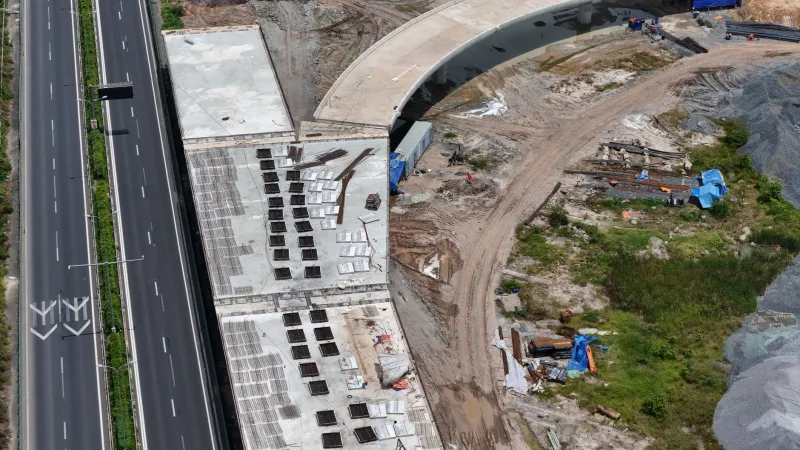
Consider the I-35 corridor expansion, a project that transportation economists have identified as among the most economically consequential infrastructure undertakings in the American Southwest. The highway serves as the primary commercial artery connecting Laredo—the busiest land port of entry in the United States—to Dallas, Austin, San Antonio, and the broader Midwest freight network. Discussions about meaningful capacity expansion have persisted for well over a decade. Environmental review processes, competing federal funding priorities, and fragmented jurisdictional authority among multiple metropolitan planning organizations have collectively ensured that completion timelines remain perpetually aspirational.
While Texas deliberates, the freight sector adapts. Logistics companies designing long-term distribution networks increasingly factor infrastructure reliability into their calculations. When a state cannot commit to a completion date, businesses plan around it—often by locating facilities elsewhere.
Port Capacity and the Competitor States Watching Closely
The Port of Houston is the nation's largest port by foreign waterborne tonnage and a genuine economic crown jewel. Yet for all its scale, the port's capacity expansion projects have faced recurring coordination breakdowns between the Army Corps of Engineers, federal appropriators, and state-level stakeholders. The Coastal Texas Protection and Restoration Study, tied to both flood resilience and channel deepening, has moved through bureaucratic channels at a pace that bears little resemblance to the urgency the project warrants.
Meanwhile, the Port of Savannah has executed a rapid deepening and expansion program that has made Georgia a more attractive destination for containerized cargo operations. The Port of Charleston is similarly investing aggressively. These are not abstract competitive threats. They represent market share that, once established, does not automatically return to Texas simply because Texas eventually completes its own work.
Every year of delay in port infrastructure translates into shipping contracts negotiated elsewhere, warehousing and distribution facilities constructed in other states, and jobs that could have been Texas jobs residing in Georgia or South Carolina payrolls instead.
The Utility Grid and the Confidence Problem
The February 2021 winter storm failure exposed vulnerabilities in the ERCOT grid that were, in many respects, decades in the making. The subsequent legislative response produced meaningful weatherization requirements, but the broader challenge of grid hardening, transmission expansion, and the integration of new generation capacity remains an ongoing and frequently contentious process.
For large industrial and commercial energy users, grid reliability is not a peripheral concern—it is a primary variable in location decisions. A semiconductor fabrication facility, a data center, or an advanced manufacturing operation requires power that is not merely abundant but dependably consistent. When Texas grid infrastructure projects face multi-year permitting delays, transmission line disputes, or funding uncertainty, the message sent to potential investors is one of institutional unreliability.
Texas has attracted extraordinary investment in the technology and manufacturing sectors in recent years, but that success should not breed complacency. The states competing for the next major semiconductor plant or hyperscale data center are actively streamlining their own utility infrastructure processes. Texas cannot afford to win the marketing battle and lose the execution contest.
Federalism as an Obstacle Course
A recurring theme across these case studies is the dysfunctional interface between federal regulatory processes and state-level infrastructure ambitions. National Environmental Policy Act reviews, which were designed to ensure thoughtful environmental consideration, have evolved into multi-year litigation magnets that delay projects regardless of their actual environmental footprint. Federal highway funding formulas reward states that navigate bureaucratic complexity, not necessarily those with the most pressing infrastructure needs.
This is not an argument against environmental responsibility or federal partnership. It is an argument for a governor's office that approaches federal-state coordination as a strategic priority rather than an administrative afterthought. McKennon has been explicit on this point: Texas needs executive leadership that is willing to engage federal agencies aggressively, leverage the state's considerable political and economic weight, and push back when federal processes are being used as instruments of indefinite delay rather than genuine oversight.
What Decisive Governance Actually Looks Like
McKennon's infrastructure agenda rests on several concrete governing commitments. First, the establishment of a dedicated Infrastructure Accountability Office within the Governor's office, charged with tracking major project timelines, identifying bureaucratic chokepoints, and escalating delays to executive attention before months become years. Accountability requires visibility, and Texas currently lacks a centralized mechanism for monitoring whether its infrastructure commitments are being met.
Second, McKennon has proposed a streamlined state-level environmental and permitting review process for projects that have already cleared federal environmental hurdles—eliminating the redundancy that currently doubles the effective timeline for many infrastructure undertakings. States like Florida have demonstrated that expedited review processes can coexist with genuine environmental stewardship.
Third, McKennon supports a dedicated infrastructure bonding authority that insulates critical projects from annual appropriations volatility. Long-term infrastructure development cannot be planned against a two-year budget cycle. Stable, dedicated financing mechanisms allow contractors, engineers, and local governments to plan with confidence rather than waiting to see whether legislative priorities shift.
The Opportunity Cost Is Not Theoretical
Texas added more than 900,000 new residents in 2022 alone. Every one of those residents requires roads that function, utilities that hold, and ports and logistics networks that keep consumer goods and industrial inputs flowing efficiently. The infrastructure demands of a state growing at Texas's pace are not static—they accelerate. A project that was adequate for 2015 population levels may be critically insufficient by 2030.
The businesses deciding today where to locate their next major facility are not waiting for Texas to resolve its coordination failures. They are making decisions based on the infrastructure Texas has built and the credibility of its commitments about what it will build next.
Leadership is, at its most fundamental level, the willingness to make decisions and be held accountable for outcomes. Texas has the resources, the talent, and the economic momentum to be the infrastructure leader of the American South. What it has lacked is the executive will to cut through bureaucratic inertia and demand results.
McKennon intends to provide exactly that. The price of waiting has already been paid in billions of lost opportunity. The cost of continued inaction is not a burden Texas can afford to carry.