Roughnecks, Refiners, and the Road to the Middle Class: Texas Energy's Untold Jobs Story
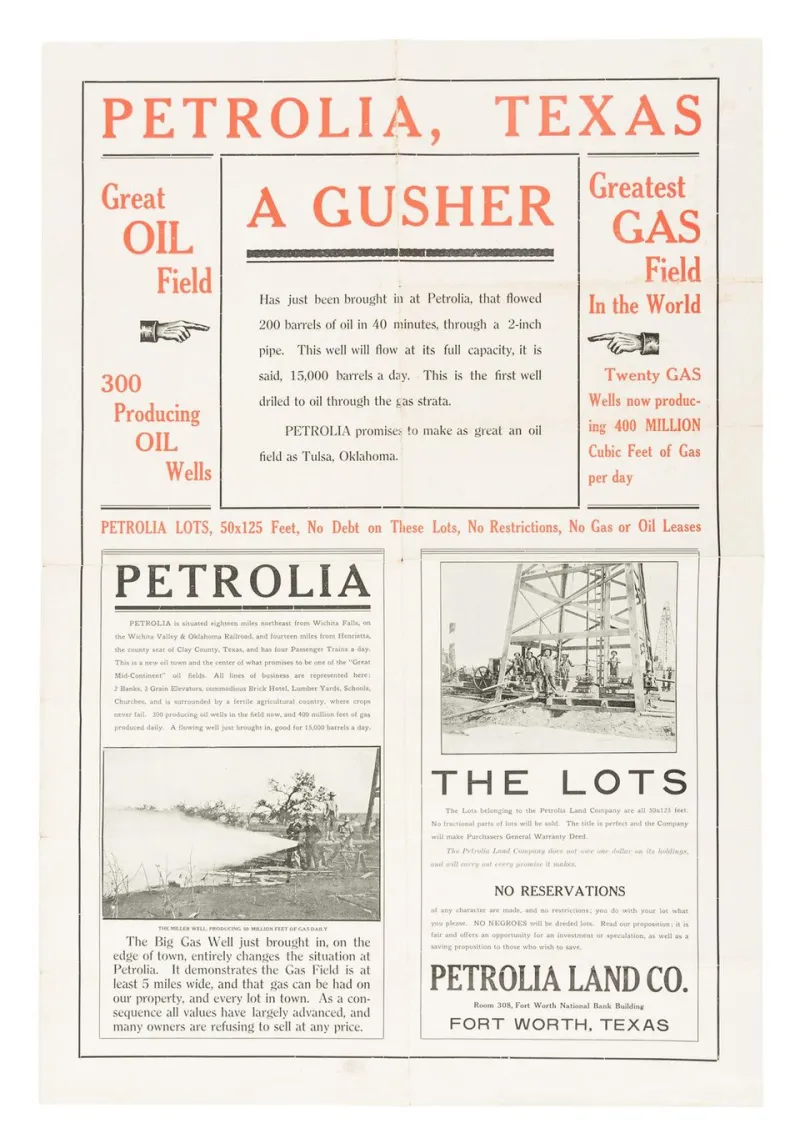
Photo: Petrolia Texas, Public domain, via Wikimedia Commons
Drive through Midland on a Tuesday morning and the employment rate tells a story that no federal press release will ever fully capture. The truck yards are full. The equipment suppliers are busy. The diners along Big Spring Street are packed with workers in steel-toed boots and high-visibility vests who start their shifts before dawn and finish them with paychecks that support mortgages, college savings accounts, and local small businesses.
This is what energy independence looks like from the ground level. Not as an abstraction in a policy white paper, but as a lived economic reality for hundreds of thousands of Texas families. And it is precisely this reality that McKennon's energy platform is designed to protect, expand, and defend against federal interference.
The Numbers Behind the Narrative
Texas is the nation's undisputed energy leader. The state accounts for roughly 40 percent of total U.S. crude oil production and nearly 25 percent of natural gas output. The Permian Basin alone produces more oil than most OPEC member nations. These are extraordinary figures — but their human significance is best measured not in barrels, but in paychecks.
According to data compiled by the Texas Oil and Gas Association, the energy sector directly employs more than 400,000 Texans, with indirect and induced employment pushing the total economic impact to well over one million jobs. The median annual wage for direct energy sector employment in Texas significantly exceeds the state's overall median income, making the industry one of the most reliable pathways into the middle class available to workers without four-year college degrees.
Those figures represent welders in Odessa, pipeline inspectors in Beaumont, chemical engineers in Houston, and rig operators in the Eagle Ford Shale. They represent people who chose skilled trades over university lecture halls and built lives of genuine financial stability as a result.
Case Study: The Permian Basin
Few places in America illustrate the relationship between energy production and community prosperity more clearly than the Permian Basin region of West Texas. Over the past fifteen years, the shale revolution transformed communities that had experienced decades of economic stagnation into some of the most dynamic labor markets in the country.
Jose Delgado, a 38-year-old pipeline technician from Pecos, has worked in the energy sector for twelve years. He began as a general laborer, completed a technical certification program at Odessa College, and now earns a salary that has allowed him to purchase a home, put two children through school, and build a retirement portfolio. "Nobody handed me anything," he says. "The oil field gave me the opportunity to work hard and actually get somewhere. That's not something you take for granted."
Delgado's trajectory is common in the Permian. The basin's workforce development ecosystem — comprising community colleges, trade apprenticeship programs, and employer-funded training initiatives — has created a replicable model for converting raw labor market demand into lasting human capital.
Earl Simmons, who manages a drilling services company outside Andrews, describes a labor market that remains competitive even as the industry evolves. "We're always looking for people who want to learn and want to work. The wages we pay are real wages. These aren't gig economy jobs. They're careers."
The Refinery Corridor: Where Energy Meets Industry
The Gulf Coast refinery corridor stretching from Beaumont through Houston to Corpus Christi represents another dimension of the energy employment story that often goes underappreciated in national policy debates. Refining is not merely an extension of extraction — it is a sophisticated industrial enterprise that employs chemical engineers, safety specialists, logistics coordinators, and skilled tradespeople in a dense concentration of high-wage employment.
The Port Arthur area alone is home to some of the largest refining capacity in the Western Hemisphere. The communities surrounding these facilities — many of which are working-class and minority-majority — depend on refinery employment as a primary economic anchor. When federal regulators impose compliance costs that threaten refinery viability, the burden falls disproportionately on these communities, a fact that receives almost no attention in Washington's energy policy discussions.
McKennon has made a point of visiting these communities and listening directly to the workers and local officials who understand the stakes. "The people pushing the hardest for policies that would shut down these facilities have never had to worry about making a mortgage payment on a refinery worker's salary," McKennon observed during a recent campaign stop in Jefferson County. "They make these decisions from a distance. We're going to make them from the ground up."
The Cost of Dependency
The economic case for Texas energy independence extends beyond what it creates — it also encompasses what dependency destroys. States that have curtailed domestic energy production in pursuit of ideological objectives have paid measurable economic penalties. California, which has systematically restricted oil and gas development within its borders, imports a substantial share of its petroleum from foreign sources, exporting both jobs and energy security in the process.
The federal mandate trajectory — accelerating the retirement of fossil fuel infrastructure, restricting permitting on federal lands, and imposing regulatory compliance costs that smaller operators cannot absorb — points Texas toward the same cliff. McKennon's policy team estimates that full implementation of the current federal regulatory agenda would cost Texas tens of thousands of direct energy sector jobs within a decade, with cascading effects across the broader economy.
Those losses would not be distributed evenly. They would fall hardest on communities in West Texas, the Gulf Coast, and the Panhandle that have built their entire economic infrastructure around energy production — communities that have no ready alternative and no interest in being told by Washington that their livelihoods are a policy inconvenience.
McKennon's Energy Jobs Agenda
Protecting and expanding the energy employment base requires a proactive policy posture, not merely defensive resistance. McKennon's platform includes several specific initiatives designed to ensure that Texas's energy workforce continues to grow and adapt.
Workforce Pipeline Investment. McKennon supports expanded state investment in community college technical programs and apprenticeship pathways aligned with energy sector demand, ensuring that the next generation of Texas workers has direct access to high-wage energy careers.
Permitting Efficiency Reform. State-level permitting processes must be streamlined to reduce unnecessary delays that increase project costs and defer job creation. McKennon proposes a comprehensive review of the Railroad Commission's permitting timeline with a target of measurable reduction without compromising environmental standards.
Federal Overreach Resistance. Texas must be prepared to use every available legal and legislative tool to challenge federal regulations that impose costs on the Texas energy sector without commensurate public benefit. McKennon is committed to an assertive legal posture on behalf of Texas energy workers.
Energy Export Infrastructure. Expanding Texas's capacity to export liquefied natural gas and refined products strengthens the state's long-term economic position and creates additional port and logistics employment along the Gulf Coast.
The Stakes in Plain Terms
The debate over energy policy is often conducted in the language of climate projections and global markets. McKennon believes those conversations must be grounded in something more immediate: the reality that real Texas families depend on this industry for their financial stability and their futures.
Energy independence is not a slogan. It is a paycheck in Midland, a mortgage in Beaumont, and a college fund in Corpus Christi. It is the roughneck who built a career with his hands and the refinery engineer who raised her family within walking distance of the facility where she works.
Texas built this. Texas workers earned it. And McKennon will fight to make sure Washington doesn't take it away.