Texans Don't Wait for Permission: A Ground-Up Strategy for Reclaiming Border Safety
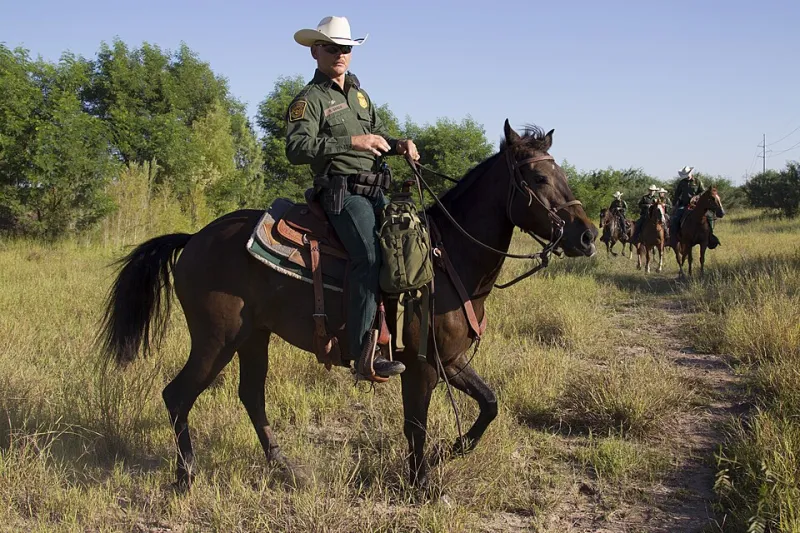
Photo: U.S. Customs and Border Protection, Public domain, via Wikimedia Commons
For too long, Texans living along the southern border — and in communities throughout the state affected by the consequences of unsecured crossings — have been told to be patient. Told to trust the process. Told that border security is a federal matter, best left to agencies in Washington whose priorities shift with each new administration. McKennon rejects that posture entirely. The safety of Texas families is not a bureaucratic negotiation. It is a governing responsibility, and it starts here.
The Federal Failure Is Not an Excuse for State Inaction
It would be easy to point at Washington and stop there. The dysfunction is real, and the frustration among border communities is entirely justified. Sectors of the Texas-Mexico border that once operated with manageable crossing volumes have experienced surges that overwhelmed local resources, strained hospital systems, and introduced criminal networks into communities that had long maintained their own sense of order and stability.
But cataloguing federal failure is not a policy. McKennon's framework begins with a clear acknowledgment: Texas cannot control what Congress does or does not pass, but Texas absolutely controls its own law enforcement infrastructure, its interagency coordination protocols, its investment in technology, and its willingness to prosecute violations under state law. That is where this administration will focus its energy.
Strengthening the Sheriff: Local Law Enforcement as the First Line of Defense
Texas has 254 counties, and in border regions, the county sheriff often represents the most immediate and most trusted law enforcement presence a community has. These are elected officials accountable directly to the people they serve — not to federal supervisors in Washington or political appointees with ideological agendas.
McKennon's plan prioritizes meaningful resource allocation to county sheriffs operating in high-pressure regions. That means dedicated state funding streams that do not evaporate when federal grant cycles end. It means equipment — vehicles, communications systems, surveillance technology — that allows rural departments to operate with the same situational awareness that better-funded urban agencies take for granted. And it means legislative backing to ensure that sheriffs have the clear statutory authority to act on violations occurring within their jurisdictions, without ambiguity about jurisdictional overlap.
Critically, this approach also includes robust data-sharing agreements between county agencies, the Texas Department of Public Safety, and the National Guard. Fragmented information is one of the most persistent operational weaknesses in border security. When a sheriff in Kinney County cannot quickly access intelligence gathered by a DPS unit in Webb County, response times suffer and criminal networks exploit the gaps. McKennon will mandate and fund the interoperability systems that close those gaps.
Operation Lone Star and Beyond: Building on What Works
Texas has already demonstrated that state-led border initiatives can produce measurable results. Operation Lone Star, whatever its implementation challenges, established a critical precedent: the state of Texas will not stand idle while federal policy creates dangerous conditions for its citizens. McKennon believes the lessons learned from that initiative — both what worked and what needed refinement — should inform a more sustainable, better-coordinated successor program.
A McKennon administration would work with the Texas Legislature to codify a standing border security framework that does not depend on emergency declarations to activate. Predictable, permanent structures are more effective than reactive surges. Landowners along the border need to know that state support is a constant, not something that appears during election cycles and recedes afterward.
This includes expanded use of fixed and mobile camera systems, sensor arrays, and aerial surveillance assets operated by the Texas Military Department. Intelligence gathered through these systems should flow directly to local law enforcement in real time, giving deputies and troopers actionable information rather than after-the-fact reports.
Prosecuting What Washington Won't
One of the most underutilized tools in Texas border security is the aggressive application of state criminal statutes. Trespassing, human smuggling under Texas Penal Code, and organized criminal activity all carry state-level charges that do not require federal cooperation to pursue. McKennon will direct the Texas Attorney General's office to work proactively with district attorneys in border counties to develop consistent prosecution strategies that hold bad actors accountable regardless of what federal immigration courts are doing.
This is not about circumventing the law. It is about using the law — every available provision of it — in service of public safety. When criminal networks understand that Texas will pursue every applicable charge, the calculus of operating within the state changes.
Community Vigilance: The Human Infrastructure of Safety
Policy and enforcement mechanisms matter enormously, but the communities most affected by border insecurity have always known something that policymakers sometimes forget: the neighbors who notice something wrong, the ranchers who report suspicious activity, the local business owners who understand the rhythms of their area — these people are an irreplaceable intelligence asset.
McKennon supports the formal expansion of community liaison programs that connect residents directly with law enforcement, creating clear and protected channels for reporting and ensuring that tips are acted upon promptly. People are more likely to engage when they trust that their information will be taken seriously and that they will not face retaliation or bureaucratic indifference in response.
Safe communities are built by people who feel invested in their safety — and who see their government investing equally in them.
A Texas Solution for Texas People
The border is not an abstraction for the families in Eagle Pass, Del Rio, or Laredo. It is their daily reality. McKennon's commitment is to govern for those families with the same seriousness they bring to living in and sustaining their communities. Washington may continue to disappoint. Texas will not.
This is what strong leadership looks like: not waiting for federal permission, not passing the responsibility to the next administration, but acting with the full force of state authority to protect the people of Texas. That is the McKennon standard, and it begins on day one.